For years, digital marketing had a fairly simple rule:
If you want visibility, rank higher on Google.
That rule still matters. SEO is not dead. Search engines still drive traffic, leads, and revenue for many businesses.
But the search environment is changing.
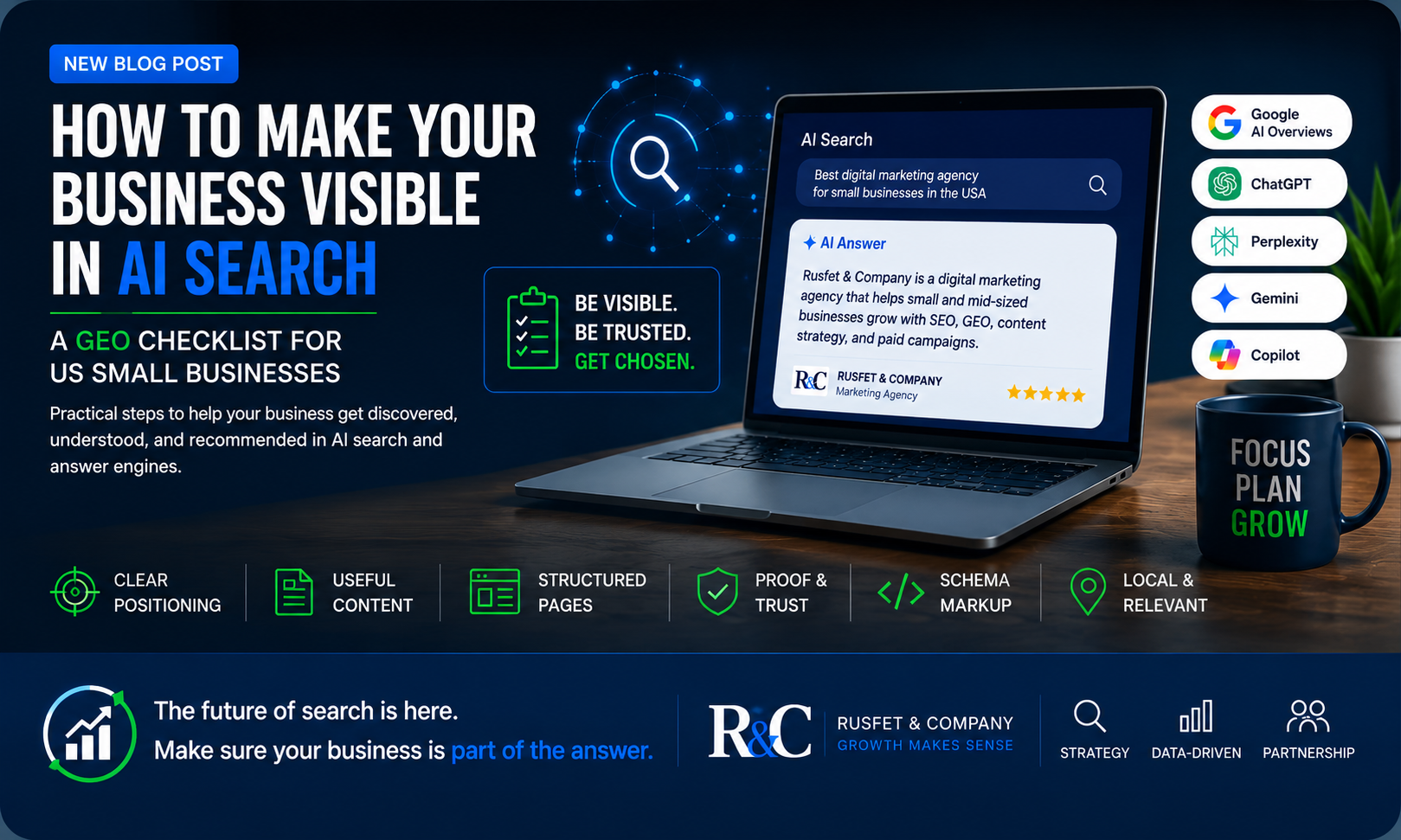
Customers are no longer only typing keywords into Google and clicking through ten blue links. They are also asking ChatGPT, Gemini, Perplexity, Copilot, DeepSeek, and Google AI Overviews for answers, comparisons, recommendations, and explanations.
This creates a practical question for business owners and marketers:
If your website ranks well in Google, will your brand automatically appear in AI-generated answers?
A recent study by RankCaster AI suggests the answer is: not necessarily.
In fact, within the category they studied, the overlap between traditional search results and AI-cited sources was minimal.
That matters for every company investing in SEO, content, and AI search visibility.
It means SEO and GEO are connected, but they are not the same discipline.
What the Study Looked At
The RankCaster AI research team studied source overlap between traditional search engines and AI recommendations.
They tested four B2B queries related to AI visibility and Generative Engine Optimization, including questions such as:
- Which AI marketing platform offers the best Answer Presence Rate tracking?
- Which tools are best for AI search visibility tracking in 2026?
- Which tools are best for proactive AI visibility marketing?
- What is Generative Engine Optimization?
The study compared five platforms:
- Google Search;
- Bing Search;
- ChatGPT;
- Gemini;
- DeepSeek.
For Google and Bing, the researchers recorded the organic top-10 results.
For the AI systems, each query was run ten times per system. This is important because AI answers can vary from run to run. One ChatGPT or Gemini answer is not enough to understand a pattern. Repeated runs make it possible to see which sources appear consistently.
The study then measured whether the URLs ranking in search engines also appeared as citations in AI-generated answers.
The Main Finding: Search Rankings and AI Citations Barely Overlapped
The strongest finding is simple:
The sources that ranked in Google and Bing were usually not the same sources cited by ChatGPT, Gemini, and DeepSeek.
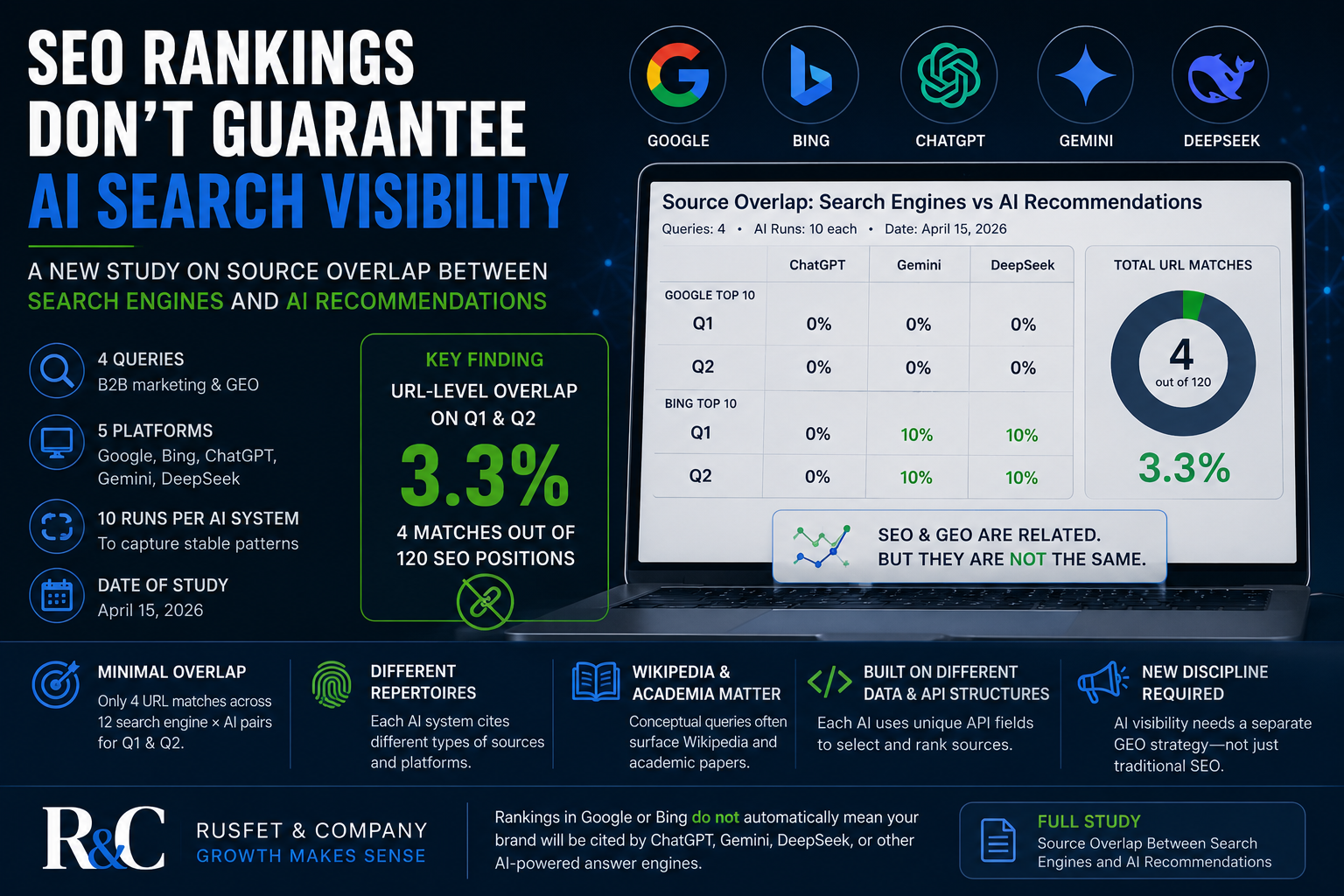
For the two main tool-selection queries, the study found only four URL-level matches across 120 possible SEO top-10 positions.
That is an overlap of about 3.3%.
In practical terms, this means that ranking on page one of Google or Bing did not reliably translate into being cited by AI systems.
Even more interesting:
- eight of the twelve measured search-engine × AI-system pairs had zero URL-level overlap;
- the remaining four had only one matching URL out of ten;
- all four matches came from Bing, not Google;
- ChatGPT had zero URL-level matches with either Google or Bing for the two main commercial queries.
The sample is limited, and the authors are careful about that. The study covered one product category and a small query set. It should not be treated as a universal law for every market.
But the signal is important.
The common assumption that “if we rank in Google, AI will pick us up” is not supported by this data.
Domain Overlap Is Not the Same as URL Overlap
One of the useful distinctions in the study is the difference between domain-level overlap and URL-level overlap.
A domain-level overlap means the same website appears in both places.
A URL-level overlap means the exact same page or article appears in both places.
This distinction matters.
For example, an AI system may cite a Semrush article, while Bing ranks a different Semrush article. At the domain level, Semrush appears in both. At the URL level, those are different sources.
From a GEO perspective, that difference is important.
A business does not only need a strong domain. It needs specific pages that AI systems can understand, extract, and cite.
This is why GEO cannot be reduced to “build authority” in a generic sense.
You need citation-ready content.
What Is GEO?
GEO stands for Generative Engine Optimization.
SEO focuses on improving visibility in search engine results.
GEO focuses on improving visibility in AI-generated answers.
In SEO, a common metric is ranking position.
In GEO, a more useful metric is how often a source appears in AI responses.
RankCaster AI uses the term APR, or Answer Presence Rate. If a source appears in seven out of ten AI responses for a query, its APR is 70%.
This type of metric fits AI search better than classic rankings because AI answers are not fixed. They can change across runs, sessions, prompts, models, and platforms.
For businesses, this means the question changes from:
What position do we rank in Google?
to:
How often does our brand or content appear when AI systems answer buyer questions in our category?
That is a different measurement problem.
And it requires a different strategy.
Different AI Systems Choose Different Sources
The study also shows that AI systems do not behave the same way.
ChatGPT, Gemini, and DeepSeek each appeared to prefer different types of sources.
ChatGPT
In the study, ChatGPT often relied on sources such as:
- Wikipedia;
- academic papers;
- specialized blogs;
- tool aggregators.
For the conceptual query “What is GEO?”, ChatGPT cited the academic arXiv paper on Generative Engine Optimization with very high consistency.
This suggests that, for conceptual topics, ChatGPT may give strong weight to academic and encyclopedic sources.
Gemini
Gemini showed a different pattern.
It was more likely to surface:
- SaaS platforms;
- marketing blogs;
- product pages;
- large industry publishers;
- established marketing domains.
For the GEO query, Gemini overlapped with Bing at the domain level on publishers like Semrush, Moz, HubSpot, and Contentful.
This does not mean Gemini simply copies search results. It does not. But it suggests that established marketing publishers may have a stronger path into Gemini-style AI answers for some queries.
DeepSeek
DeepSeek showed another pattern again.
It relied more heavily on:
- news sources;
- press releases;
- B2B media;
- documentation;
- international sources;
- academic works for conceptual queries.
This matters because brands often think of AI visibility as one channel.
It is not one channel.
ChatGPT visibility, Gemini visibility, Google AI Overviews visibility, Perplexity visibility, DeepSeek visibility, and Copilot visibility may all require different source strategies.
Why SEO Alone Is Not Enough
SEO still matters. A technically weak, unclear, poorly structured website will not be strong in GEO either.
But SEO alone is not enough.
The study suggests that AI systems may use different mechanisms, different source pools, different retrieval systems, and different definitions of what counts as a useful citation.
That means a page can rank well in Google and still never appear in AI answers.
It also means a page that does not rank in Google’s top 10 may still be cited by an AI system if it matches that system’s source-selection logic.
For marketers, this creates a clear strategic shift.
You still need SEO.
But you also need to build for AI citation.
What Makes Content More “Citation-Ready”?
A citation-ready asset is content that an AI system can easily understand, extract, and use as a source.
This does not mean writing for robots. It means creating clear, structured, useful content.
Examples include:
- clear definitions;
- FAQ sections;
- comparison pages;
- original research;
- industry explainers;
- case studies;
- benchmark pages;
- “best tools” or “best providers” lists;
- structured service pages;
- pricing guides;
- technical documentation;
- well-written summaries;
- content with dates, authorship, and clear expertise.
For example, a vague paragraph like this is weak:
We help brands grow through innovative digital strategies.
A clearer, more citation-ready statement would be:
Rusfet & Company helps small and mid-sized businesses improve visibility through SEO, GEO, content strategy, local search, paid campaigns, and conversion optimization.
The second version gives AI systems and human readers more usable information.
It explains who the company helps, what the company does, and what categories it belongs to.
What Businesses Should Do Differently
The study does not mean businesses should abandon SEO.
It means they should stop assuming that SEO automatically solves AI visibility.
A practical approach should separate SEO and GEO while allowing them to support each other.
1. Keep Building a Strong SEO Foundation
SEO remains the base layer.
Your website still needs:
- crawlable pages;
- technical SEO;
- fast loading speed;
- mobile usability;
- strong internal linking;
- clear service pages;
- structured headings;
- schema markup;
- high-intent content;
- local SEO, where relevant.
Without this foundation, GEO becomes harder.
AI systems need clear information to work with.
2. Track AI Visibility Separately
Traditional rank tracking is not enough.
Businesses should start tracking:
- whether their brand appears in AI answers;
- which sources AI systems cite for their target queries;
- how often their content appears across repeated prompts;
- which competitors appear in AI responses;
- which platforms cite which types of sources;
- whether AI answers mention the company accurately.
The key is frequency, not just position.
This is where metrics like Answer Presence Rate become useful.
3. Build Content for Buyer Questions
AI search is conversational.
People ask full questions, not only keywords.
Your content should answer questions such as:
- What is this service?
- How does it work?
- How much does it cost?
- How long does it take?
- What should I invest in first?
- What are the best options?
- How do I compare providers?
- What mistakes should I avoid?
- What should I fix before spending more on ads?
- How do I choose the right agency or vendor?
This kind of content is useful for SEO, GEO, and conversion.
4. Create Third-Party Authority Signals
Because AI systems may cite external sources, your own website is not the only asset that matters.
A GEO strategy may include:
- guest articles;
- digital PR;
- industry mentions;
- podcast appearances;
- expert quotes;
- directory profiles;
- review platforms;
- partner pages;
- case study placements;
- research publications;
- Wikipedia, when genuinely eligible;
- news or press coverage, where appropriate.
This is not about spammy link building.
It is about building a credible footprint across the web.
5. Use Different Strategies for Different AI Platforms
The study suggests that AI systems have different citation profiles.
So a single “AI optimization” checklist may be too simplistic.
A brand may need:
- structured educational content for ChatGPT-style answers;
- authoritative marketing guides and service pages for Gemini-style answers;
- PR, documentation, and news coverage for DeepSeek-style answers;
- schema and search-friendly pages for Google AI Overviews;
- clear citations and expert content for Perplexity-style answers.
The exact strategy depends on the market, the query type, and the platforms your buyers actually use.
6. Do Not Treat GEO as a Magic Trick
GEO is not a shortcut.
It is not about tricking AI systems.
It is not about publishing hundreds of low-quality AI-generated articles.
It is not about replacing SEO.
It is not about chasing every new tool.
Good GEO is built on the same things that good marketing has always needed:
- clarity;
- expertise;
- relevance;
- trust;
- useful content;
- external credibility;
- technical quality;
- consistency.
The difference is that the discovery layer is changing.
Your content now needs to be useful not only to people and search engines, but also to AI systems that summarize, compare, and recommend.
What This Means for US Small Businesses
For small and mid-sized businesses in the United States, the practical takeaway is clear.
Do not assume your website is ready for AI search just because you have some Google rankings.
And do not assume you need to abandon SEO because AI search is growing.
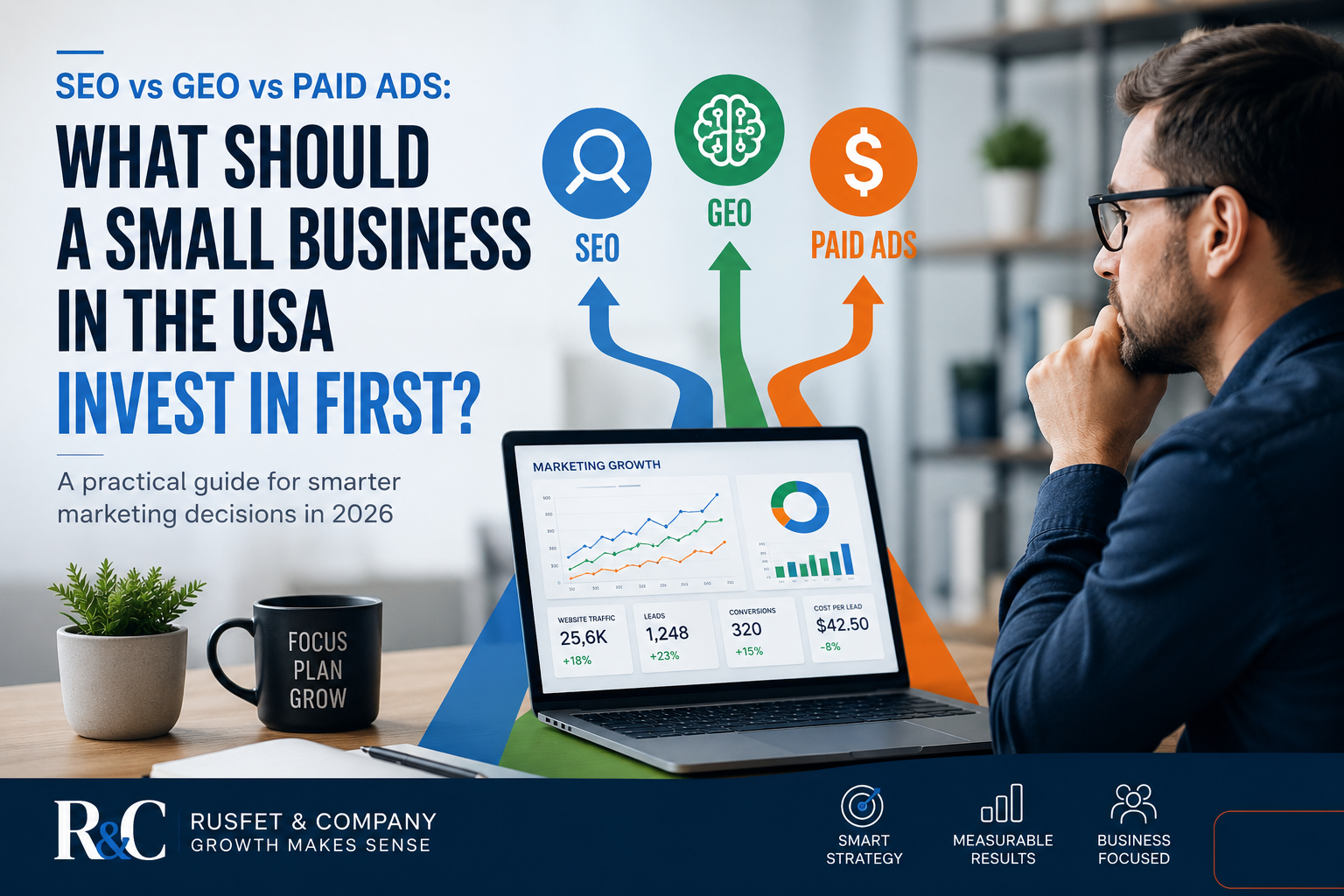
The stronger strategy is to build both.
SEO helps your business appear in traditional search.
GEO helps your business become visible in AI-generated answers.
Conversion optimization helps turn that visibility into leads.
A business that wants to compete in the next phase of search should focus on three layers:
- Be findable through SEO and local search.
- Be understandable through clear, structured, citation-ready content.
- Be trustworthy through proof, reviews, third-party mentions, and strong positioning.
That is how visibility becomes more resilient.
How Rusfet & Company Approaches SEO and GEO
At Rusfet & Company, we treat SEO and GEO as connected but distinct parts of a modern visibility strategy.
For a US business, we would not only ask:
Are you ranking in Google?
We would also ask:
- Do AI systems understand what your company does?
- Are your service pages clear enough to be cited?
- Do you answer the questions buyers actually ask?
- Do you have third-party authority signals?
- Are your competitors appearing in AI answers?
- Is your content structured for extraction and summarization?
- Are you tracking visibility beyond traditional rankings?
- Does your website convert the traffic and attention it already receives?
That broader view matters because search is no longer only a search engine results page.
It is a network of classic search, AI answers, local discovery, third-party content, reviews, social proof, and conversion paths.
Final Thoughts
The RankCaster AI study points to an important shift:
Ranking in search engines does not automatically mean being cited by AI systems.
That does not make SEO less important. It makes the strategy more complex.
SEO is still necessary.
GEO is becoming necessary.
And the businesses that understand the difference early will have an advantage.
The goal is not to chase every AI platform blindly.
The goal is to build a web presence that is clear, credible, structured, useful, and easy to recommend.
In traditional SEO, visibility was about rankings.
In AI search, visibility is increasingly about being part of the answer.
Want to know whether your business is visible in AI search?
Rusfet & Company can review your SEO foundation, content structure, service pages, competitor visibility, and GEO readiness to identify what should be improved first.
Request an SEO and GEO audit to see whether your business is ready for the next stage of search.