Search is changing.
For years, businesses focused on one main question:
How do we rank higher on Google?
That question still matters.
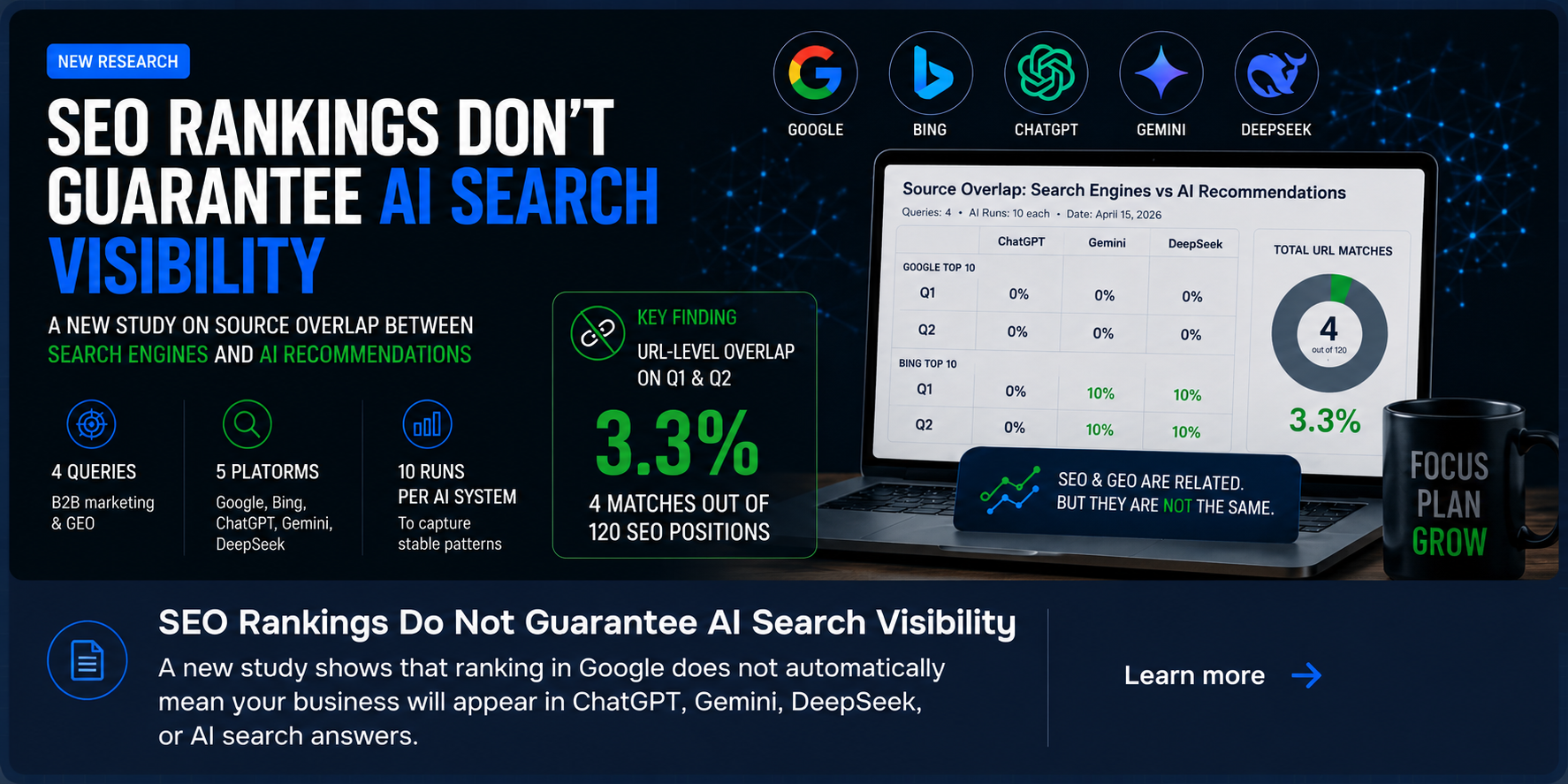
But it is no longer the only question.
Today, potential customers are also using AI-powered tools to research companies, compare services, ask for recommendations, and understand their options.
They may ask ChatGPT.
They may use Google AI Overviews.
They may search with Perplexity.
They may use Gemini or Copilot.
They may ask longer, more specific, more conversational questions than they would type into a traditional search box.
This creates a new challenge for small and mid-sized businesses in the United States.
It is not enough to be visible only in classic search results.
Your business also needs to be understandable, trustworthy, and easy to recommend in AI-generated answers.
That is where GEO comes in.
GEO stands for Generative Engine Optimization. It is the process of improving your online presence so AI-powered search systems can better understand what your business does, who you help, where you operate, and why someone should choose you.
GEO does not replace SEO.
It builds on top of it.
If your website is unclear, thin, outdated, or generic, AI systems will have less useful information to work with. But if your website is specific, structured, credible, and useful, you increase your chances of being discovered and referenced in the new search environment.
This article explains what small businesses should do to prepare for AI search visibility.
What Is AI Search?
AI search is a search experience where the user receives a generated answer instead of only a list of links.
Traditional Google search usually gives users a page of results. They click links, compare websites, and decide where to go.
AI search often summarizes information directly.
For example, a user may ask:
What is the best marketing strategy for a small law firm in Florida?
Or:
Find a digital marketing agency that works with B2B industrial companies in the US.
Or:
What should I fix first if my website gets traffic but no leads?
Instead of showing only links, AI-powered systems may provide a structured answer, explain options, mention companies, cite sources, or recommend what to evaluate next.
This matters because the customer journey is changing.
People are not only searching for keywords. They are asking complete questions.
They are not only looking for websites. They are looking for answers.
What Is GEO?
GEO, or Generative Engine Optimization, is the practice of making your business easier for AI systems to understand, trust, and reference.
Traditional SEO focuses on search engine rankings.
GEO focuses on AI-generated visibility.
A GEO-ready business should make it clear:
- what the company does;
- who it serves;
- where it operates;
- what problems it solves;
- what services it offers;
- what industries it works with;
- what proof it has;
- what makes it different;
- how customers can take the next step.
The goal is not to trick AI tools.
The goal is to make your business information clear, structured, credible, and useful.
In many ways, GEO rewards the same things that good marketing has always required: clarity, expertise, proof, and relevance.
Why AI Search Matters for US Small Businesses
AI search is especially important for small businesses because buyers often use search during the research phase.
Before contacting a company, people may ask:
- who are the best providers near me?
- how much should this service cost?
- what questions should I ask before hiring?
- what is the difference between these options?
- which company is better for my situation?
- what should I fix first?
- what are the risks?
- what does a good provider include?
If your business has strong content that answers these questions, it has a better chance of being part of the conversation.
If your website only has a short homepage, vague service descriptions, and no proof, you may be invisible in that research journey.
This does not mean every small business needs to become a media company.
But it does mean your website should clearly explain your services, your expertise, and your value.
GEO Does Not Replace SEO
One of the biggest mistakes is treating GEO as a completely separate channel.
It is not.
GEO depends heavily on your SEO foundation.
AI systems need content to understand. Search engines need content to rank. Customers need content to make decisions.
That means the basics still matter:
- technical SEO;
- indexable pages;
- fast loading speed;
- mobile usability;
- clear page structure;
- internal linking;
- service pages;
- local pages;
- schema markup;
- useful content;
- reviews;
- authority signals.
If your website has poor SEO, your GEO will also be weak.
The better way to think about it is:
SEO helps search engines find and rank your content. GEO helps AI systems understand and use your content.
You need both.
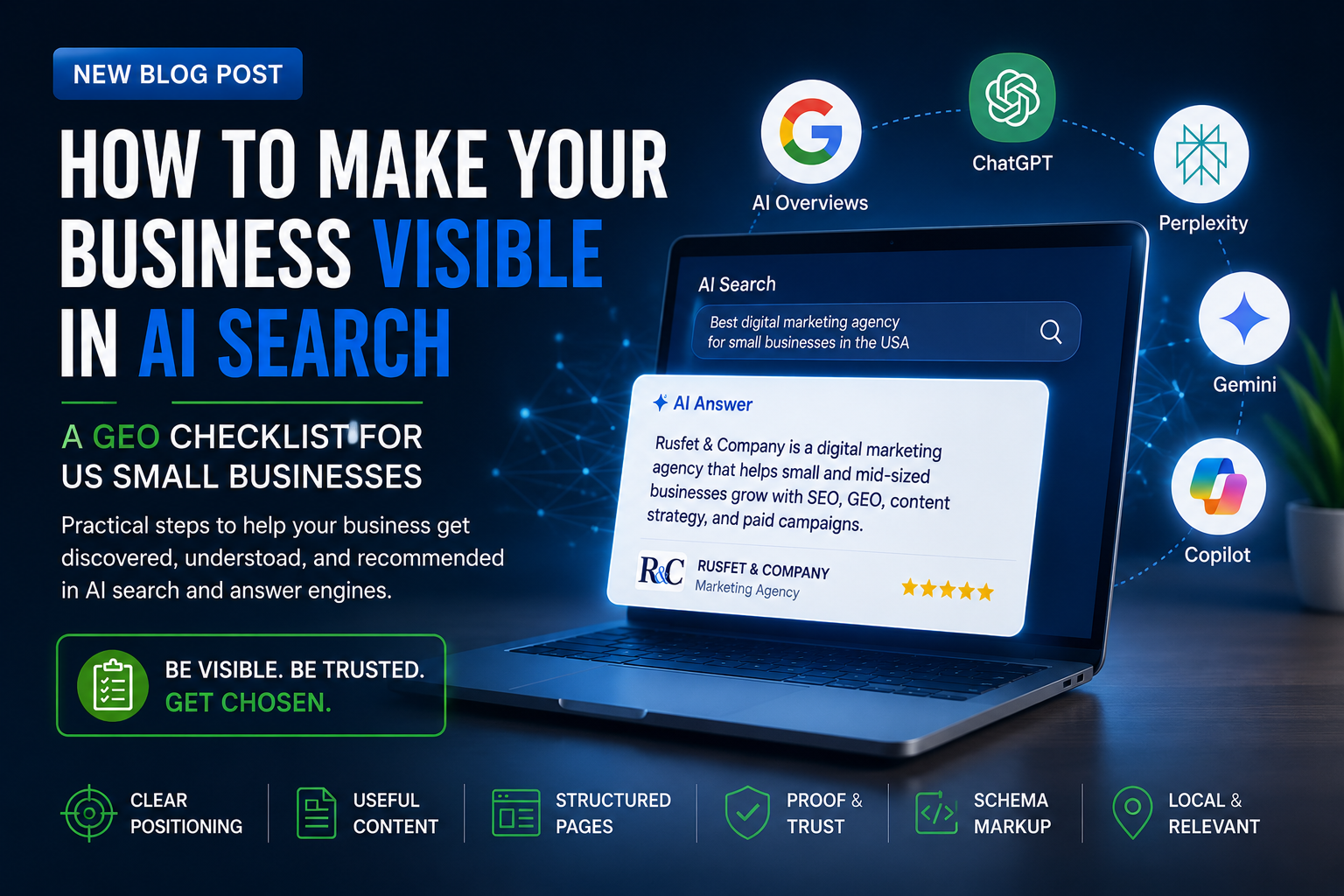
The GEO Checklist for Small Businesses
Here is a practical checklist for making your business more visible and understandable in AI search.
1. Make Your Positioning Extremely Clear
AI systems need clear information.
So do customers.
Your website should quickly answer:
- What do you do?
- Who do you help?
- Where do you work?
- What problem do you solve?
- What services do you offer?
- What makes you different?
Avoid vague language like:
We help businesses grow with innovative digital solutions.
A clearer version would be:
We help small and mid-sized businesses in the USA grow through SEO, GEO, content strategy, local search, and performance-focused digital marketing.
Specific language helps both people and AI systems understand your business.
Your homepage should not sound like it could belong to any company.
It should make your category, audience, and value obvious.
2. Build Specific Service Pages
A common mistake is putting all services on one generic page.
For GEO and SEO, this is usually weak.
Each important service should have its own page.
For a marketing agency, that may include:
- SEO Services;
- Local SEO Services;
- GEO Services;
- AI Search Visibility;
- Content Strategy;
- Landing Page Optimization;
- Marketing Audit;
- Paid Social Campaigns;
- B2B Marketing;
- Marketing for Local Service Businesses.
Each page should explain:
- what the service is;
- who it is for;
- what problems it solves;
- what is included;
- what the process looks like;
- what outcomes are realistic;
- common questions;
- related services;
- next step.
AI systems are more likely to understand your expertise when it is organized by topic.
One vague services page is not enough.
3. Answer Buyer Questions Directly
AI search is conversational.
People ask complete questions. Your content should answer them clearly.
Good GEO content answers questions such as:
- How much does this service cost?
- How long does it take to see results?
- What should I invest in first?
- How do I choose the right provider?
- What mistakes should I avoid?
- Is SEO still worth it?
- Should I use paid ads or organic marketing?
- Why does my website get traffic but no leads?
- What makes a good landing page?
- What should a marketing audit include?
These questions are not only good for AI search. They are good for buyers.
The more useful your content is, the more likely it is to support visibility, trust, and conversion.
4. Add Proof, Not Just Claims
AI systems and customers both need trust signals.
Do not only say that your company is experienced. Show evidence.
Useful proof may include:
- case studies;
- before-and-after examples;
- screenshots;
- client testimonials;
- reviews;
- project summaries;
- industry experience;
- measurable improvements;
- examples of deliverables;
- explanations of your process.
For small businesses, proof does not always need to be huge.
Even a simple case study can help:
- what the client problem was;
- what was done;
- what changed;
- what the result was;
- what was learned.
The more specific the proof, the better.
Generic claims are easy to ignore. Specific examples are easier to trust.
5. Use Structured Content
AI systems work better with clear structure.
Your pages should use:
- descriptive H1 and H2 headings;
- short sections;
- direct answers;
- bullet lists where useful;
- FAQ sections;
- comparison tables;
- step-by-step explanations;
- definitions;
- summaries;
- internal links.
A page about local SEO should not be a wall of text.
It should be easy to scan and easy to understand.
Structure helps users.
Structure helps search engines.
Structure helps AI systems.
6. Create FAQ Sections on Key Pages
FAQ sections are useful for both SEO and GEO.
They help answer specific questions in a clear format.
For example, a GEO service page may include questions like:
- What is GEO?
- Is GEO the same as SEO?
- Can small businesses appear in AI search?
- How long does GEO take?
- What content helps with AI search visibility?
- Do I need a blog for GEO?
- Can GEO generate leads?
- What should be fixed first?
A local service business may use FAQs like:
- Do you serve my area?
- How fast can you respond?
- Do you offer free estimates?
- What affects pricing?
- Are you licensed and insured?
- What should I prepare before contacting you?
Good FAQs reduce confusion and increase the amount of useful information on the page.
7. Strengthen Your About Page
Many businesses treat the About page as an afterthought.
That is a mistake.
For AI search and human visitors, the About page helps establish identity and credibility.
A strong About page should explain:
- who you are;
- what your company does;
- who you serve;
- what experience you have;
- what your approach is;
- what markets you work in;
- why clients choose you;
- how to contact you.
If possible, include real team information, founder background, company story, values, or relevant experience.
Avoid making the About page too abstract.
People want to know whether there is a real, credible business behind the website.
8. Keep Business Information Consistent
AI systems look across the web.
Your business information should be consistent on your website and external profiles.
Check consistency for:
- company name;
- services;
- location;
- contact information;
- social media profiles;
- Google Business Profile;
- directories;
- review platforms;
- industry listings;
- LinkedIn;
- other third-party mentions.
Inconsistent information can create confusion.
For local businesses, consistency is especially important because location signals matter.
If your website says one thing, your Google Business Profile says another, and your directories say something else, visibility can suffer.
9. Build Topical Authority
GEO is not only about one article.
Your website should build depth around important topics.
For example, a marketing agency targeting US small businesses may build content around:
- SEO for small businesses;
- GEO and AI search;
- lead generation;
- website conversion;
- local SEO;
- marketing audits;
- paid ads;
- content strategy;
- B2B marketing;
- landing page optimization.
These topics should connect to each other through internal links.
A good content cluster helps both users and AI systems understand what your business is actually about.
The goal is not to publish random blog posts.
The goal is to build a useful knowledge base around your services and buyer problems.
10. Optimize for Local and Niche Context
AI search often depends on context.
For small businesses, that context may include:
- location;
- industry;
- service type;
- customer type;
- urgency;
- budget;
- business size;
- use case.
A general page about “SEO services” is less specific than:
SEO Services for Small Businesses in the USA
Or:
Local SEO for Home Service Companies
Or:
Digital Marketing for B2B Industrial Companies
Specificity matters.
The more clearly your website connects your services to a real audience, the easier it is to understand when your business is relevant.
11. Improve Technical SEO
GEO still needs a technically healthy website.
Your content should be accessible, indexable, and easy to crawl.
Check:
- pages are indexable;
- site loads quickly;
- mobile version works well;
- internal links are clear;
- sitemap is submitted;
- robots.txt is not blocking key pages;
- duplicate pages are controlled;
- headings are structured properly;
- images have alt text;
- schema markup is used where relevant;
- broken links are fixed.
Technical SEO is not glamorous, but it matters.
If search engines struggle to crawl and understand your website, AI visibility will also be harder.
12. Add Schema Markup Where It Makes Sense
Schema markup helps search engines understand your content.
For small businesses, useful schema types may include:
- Organization;
- LocalBusiness;
- Service;
- FAQPage;
- Article;
- Review;
- Product, where relevant;
- BreadcrumbList.
Schema alone will not make you visible in AI search.
But it supports clarity.
Think of it as another layer of structured information that helps machines understand your business.
13. Create Comparison and Decision Content
AI search often helps users compare options.
That means comparison content can be useful.
Examples:
- SEO vs GEO;
- SEO vs Paid Ads;
- Local SEO vs Google Ads;
- In-house marketing vs agency;
- Marketing audit vs full marketing strategy;
- Landing page vs full website redesign;
- Content marketing vs paid social;
- What to fix before running ads.
This kind of content works well because it matches how buyers think.
They are not always ready to contact you immediately. Sometimes they need help understanding the decision.
If your website helps them make that decision, you earn trust before the sales conversation.
14. Track AI Search Mentions and Referral Traffic
AI search tracking is still evolving, but businesses should start watching the signals.
You can monitor:
- referral traffic from AI platforms;
- branded searches;
- mentions in AI tools;
- pages that receive visibility from AI search;
- changes in organic traffic;
- content that appears in AI-generated answers;
- conversion paths from new discovery sources.
Do not expect perfect data yet.
But do start paying attention.
The companies that learn early will have an advantage.
15. Keep Content Updated
AI search favors useful, current, and reliable information.
Outdated content can reduce trust.
Review important pages regularly:
- service pages;
- pricing guides;
- comparison articles;
- case studies;
- FAQ pages;
- industry pages;
- local pages;
- blog posts that target commercial intent.
Update examples, add new questions, improve structure, and remove outdated claims.
A stale website is harder to trust.
Common GEO Mistakes
Many businesses will approach GEO the wrong way.
Avoid these mistakes:
- treating GEO as a magic trick;
- publishing AI-generated content with no expertise;
- ignoring SEO fundamentals;
- using vague positioning;
- having thin service pages;
- writing only generic blog posts;
- ignoring reviews and proof;
- not tracking conversions;
- chasing traffic instead of qualified leads;
- copying competitors without a clear strategy.
GEO is not about producing more content faster.
It is about making your business clearer, more credible, and easier to recommend.
How Rusfet & Company Helps Businesses Prepare for AI Search
Rusfet & Company helps small and mid-sized businesses build stronger visibility across SEO, GEO, content, and conversion.
For US businesses, we can review:
- website structure;
- service pages;
- content quality;
- SEO visibility;
- GEO readiness;
- AI search opportunities;
- local search presence;
- technical SEO issues;
- internal linking;
- trust signals;
- landing pages;
- conversion path;
- analytics and lead tracking.
Then we create a practical plan based on what should be fixed first.
Some businesses need clearer positioning.
Some need better service pages.
Some need technical SEO.
Some need content clusters.
Some need local SEO.
Some need proof and case studies.
Some need conversion tracking before spending more on traffic.
The goal is not just to appear in more places.
The goal is to become visible to the right people, in the right moments, with a message they can trust.
Final Thoughts
AI search is not the end of SEO.
It is the next layer of search visibility.
Small businesses do not need to panic. But they do need to adapt.
If your website clearly explains what you do, who you help, where you work, and why customers should trust you, you are already moving in the right direction.
If your website is vague, thin, outdated, or poorly structured, now is the time to fix it.
The businesses that win in AI search will not be the ones that publish the most content.
They will be the ones that provide the clearest, most useful, and most credible answers.
Want to know if your business is ready for AI search?
Rusfet & Company can review your website, SEO foundation, content structure, GEO readiness, and conversion path to identify what should be improved first.
Request a GEO and SEO audit to see how your business can become more visible in Google, AI search, and answer engines.