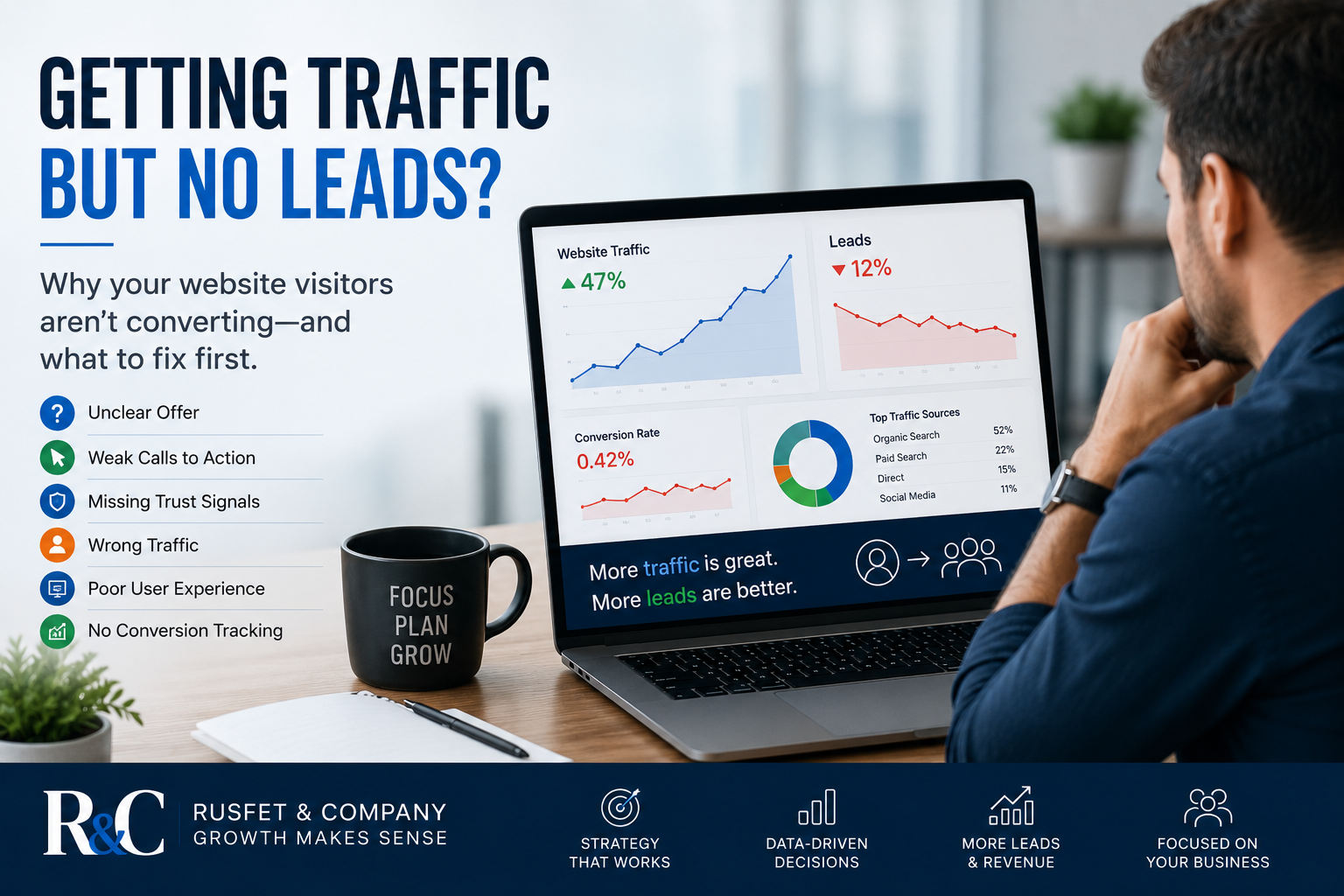
Your website is getting visitors.
Google Analytics shows traffic. Maybe your SEO is improving. Maybe you are running paid ads. Maybe people are finding you through social media, local search, referrals, or AI-powered search tools.
But there is one problem.
The phone is not ringing.
Forms are not coming in.
Quote requests are weak.
Visitors leave without taking action.
For many small and mid-sized businesses in the United States, this is one of the most frustrating marketing problems. You are doing the work. You are investing in visibility. People are landing on your website.
But the traffic is not turning into leads.
The common reaction is to ask for more traffic.
More SEO.
More ads.
More social media.
More blog posts.
More impressions.
But more traffic is not always the answer.
Sometimes the real bottleneck is the website itself.
A business website should not only attract visitors. It should help the right visitors understand your offer, trust your company, and take the next step.
Before spending more money on SEO, GEO, paid ads, or social media, it is worth asking a simpler question:
Can your website convert the traffic you already have?
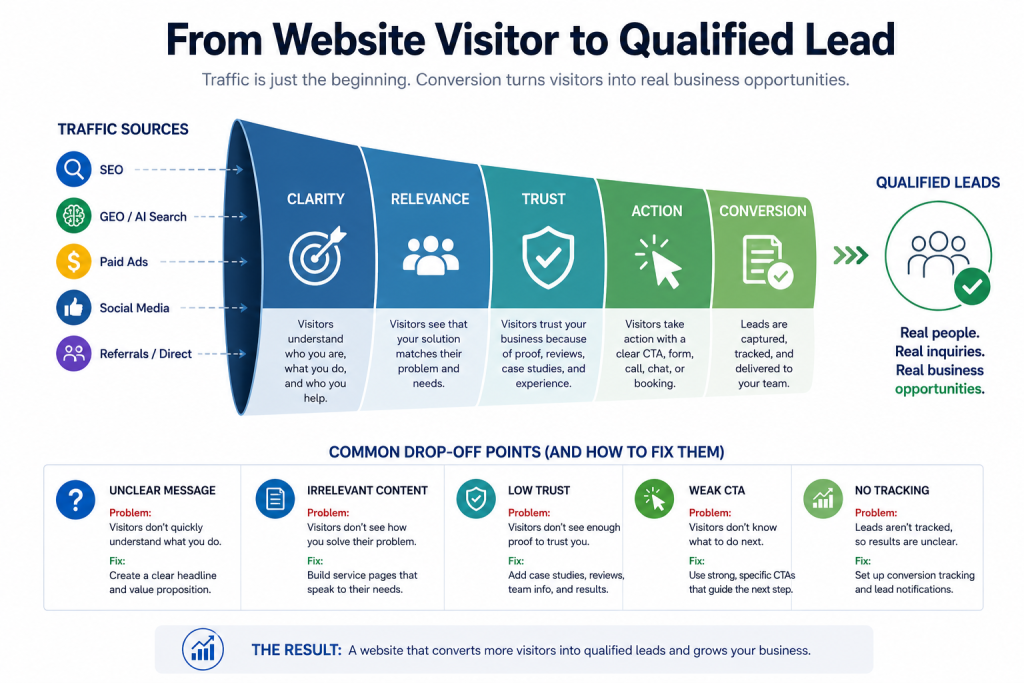
Traffic Does Not Equal Leads
Website traffic is useful only when it brings the right people to the right page with the right intent.
A thousand visitors who are not ready to buy may be less valuable than fifty visitors actively looking for your service.
This is especially important for small businesses. Most small companies cannot afford to treat marketing as a vanity project. Traffic, rankings, clicks, and impressions matter only if they help create real business opportunities.
A website can fail to generate leads for several reasons:
- the offer is unclear;
- the service pages are too generic;
- the website does not build enough trust;
- the calls to action are weak;
- the mobile experience is poor;
- the traffic is coming from the wrong audience;
- conversion tracking is missing or inaccurate;
- forms, phone numbers, or lead notifications are broken;
- visitors do not understand what to do next.
The good news is that many of these problems can be fixed.
But first, you need to identify whether the issue is traffic quality, website conversion, or tracking.
Reason 1: Your Offer Is Not Clear Enough
One of the most common reasons a website gets traffic but no leads is simple: visitors do not immediately understand what the business does.
Many websites use language that sounds professional but says very little.
For example:
We help businesses grow through innovative solutions.
That sentence could describe thousands of companies. It does not explain who the business helps, what problem it solves, or why someone should contact them.
A stronger version would be:
We help local service businesses in the USA generate more qualified leads through SEO, local search, landing pages, and paid campaigns.
This is clearer because it explains:
- who the company helps;
- where it works;
- what services it provides;
- what result the client wants.
Your website headline should pass the five-second test.
When someone lands on your homepage or service page, they should quickly understand:
- what you do;
- who you do it for;
- what problem you solve;
- what makes you relevant;
- what they should do next.
If visitors have to work too hard to understand your offer, most of them will leave.
Clarity usually converts better than cleverness.
Reason 2: Your Service Pages Are Too Generic
A lot of small business websites have one broad “Services” page that lists everything the company does.
That may be enough for a brochure. It is usually not enough for SEO, GEO, or lead generation.
If your business offers multiple services, each important service should usually have its own page.
For example, a marketing agency should not rely only on one “Digital Marketing Services” page. It may need separate pages for:
- SEO services;
- local SEO services;
- GEO and AI search visibility;
- paid social campaigns;
- Google Ads audit;
- landing page optimization;
- content strategy;
- marketing audit;
- B2B marketing;
- marketing for local service businesses.
The same principle applies to many industries.
A contractor may need separate pages for kitchen remodeling, bathroom remodeling, basement finishing, roofing, and emergency repairs.
A law firm may need separate pages for personal injury, immigration, business law, estate planning, and employment law.
A medical clinic may need separate pages for each major treatment or service.
Generic pages create generic results.
Strong service pages should answer specific buyer questions:
- What is this service?
- Who is it for?
- What problem does it solve?
- What is included?
- What makes your approach different?
- What should the customer expect?
- How much does it cost, or what affects pricing?
- Why should the visitor trust you?
- What is the next step?
A service page should not simply describe the service. It should help the visitor make a decision.
Reason 3: Your Website Does Not Build Enough Trust
People do not contact businesses they do not trust.
This is especially true in the US market, where customers often compare several providers before making a decision.
Trust is not built by saying “we are reliable” or “we are professional.” Trust is built through proof.
Useful trust signals include:
- case studies;
- testimonials;
- reviews;
- before-and-after examples;
- client logos, if available;
- industry experience;
- certifications;
- team information;
- real photos;
- clear contact details;
- transparent process;
- examples of previous work;
- recognizable locations served;
- specific results, when they can be shown honestly.
For many service businesses, the About page is also important. Visitors want to know who is behind the company.
A faceless website with generic stock photos, vague copy, and no proof will struggle to convert, even if the service is good.
If visitors do not trust you, they will not contact you.
Even worse, they may use your website to learn about the service, then contact a competitor who looks more credible.
Reason 4: Your Calls to Action Are Weak
A call to action tells the visitor what to do next.
Many websites use weak or vague buttons such as:
- Learn More
- Submit
- Click Here
- Read More
- Get Started
These are not always wrong, but they often lack context.
A stronger CTA is specific and aligned with the visitor’s intent.
For example:
- Request a Marketing Audit
- Book a Consultation
- Get a Free Website Review
- Ask for a Quote
- Schedule a Call
- Check My Website
- Discuss Your Growth Plan
- Request Pricing
- Contact a Specialist
The CTA should match the business model.
If the service is complex or expensive, “Buy Now” may be too aggressive. “Book a Consultation” or “Request an Audit” may work better.
If the business is local and urgent, “Call Now” may be the strongest option.
If the offer requires a quote, “Request a Quote” is clear and direct.
A good website usually has one primary CTA and one secondary CTA.
For example:
Primary: Request a Marketing Audit
Secondary: View Case Studies
This gives visitors a clear path without overwhelming them.
Reason 5: Your Website Is Built for Design, Not Decisions
A website can look beautiful and still fail to generate leads.
Design matters, but business websites are not art projects. They are decision-making tools.
A good website should guide visitors from problem to solution to action.
That means the structure matters.
Visitors should quickly find:
- what you offer;
- who you help;
- why it matters;
- why they should trust you;
- what results are possible;
- how your process works;
- what the next step is.
Many websites fail because they focus too much on visual style and not enough on user decisions.
Common problems include:
- the headline is vague;
- the CTA is hidden;
- the menu is confusing;
- service pages are too thin;
- there is no proof;
- the copy is too abstract;
- the mobile version is hard to use;
- pages load slowly;
- forms ask for too much information;
- the visitor has no reason to act now.
Your website does not need to be complicated. It needs to be clear, credible, and easy to use.
Reason 6: You Are Attracting the Wrong Traffic
Sometimes the website is not the main problem. Sometimes the traffic is wrong.
This often happens when businesses focus on volume instead of intent.
For example, a blog article may bring visitors who are researching a topic but not looking for a service.
A paid campaign may target too broad an audience.
A social media campaign may bring engagement but no buyers.
An SEO strategy may rank for informational keywords but miss commercial keywords.
AI search visibility may bring people who are curious, but not ready to contact a vendor.
This does not mean informational traffic is useless. It can build awareness, trust, and remarketing audiences.
But if your goal is lead generation, you need pages and campaigns designed for commercial intent.
There is a difference between someone searching:
how does SEO work
and someone searching:
SEO agency for small business in USA
The first person may be learning.
The second person may be evaluating providers.
Both can matter, but they should not be measured the same way.
To improve lead generation, your strategy should separate:
- informational keywords;
- commercial keywords;
- local keywords;
- branded keywords;
- comparison keywords;
- problem-aware searches;
- solution-aware searches;
- ready-to-buy searches.
The closer the visitor is to a buying decision, the more direct your page should be.
Reason 7: You Are Not Tracking Real Conversions
Many businesses think their website is not generating leads because they are looking at incomplete data.
Others think their marketing is working because traffic is growing, but they cannot connect that traffic to real inquiries.
Basic traffic data is not enough.
You need to track actions that matter.
Depending on your business, this may include:
- form submissions;
- phone calls;
- quote requests;
- booked meetings;
- email clicks;
- chat starts;
- downloads;
- demo requests;
- purchases;
- appointment bookings;
- newsletter signups;
- CRM-qualified leads.
You should also know where those leads came from.
Did they come from organic search?
Paid ads?
Local search?
Social media?
Referral traffic?
AI search?
Email?
Direct visits?
Without proper tracking, you cannot know which channels are actually working.
This leads to poor decisions.
You may cut a channel that is bringing good leads.
You may increase spending on a channel that brings low-quality leads.
You may blame SEO when the real issue is the landing page.
You may blame ads when the real issue is the offer.
You may blame the website when the real issue is broken tracking.
Before scaling marketing, fix analytics.
The Website Conversion Checklist
Use this checklist to evaluate whether your website is ready to turn visitors into leads.
Above the Fold
The first screen of your website should answer the most important questions quickly.
Check if you have:
- a clear headline;
- a specific value proposition;
- a visible primary CTA;
- a trust signal;
- a clear explanation of who you help;
- location or target market, if relevant;
- no unnecessary visual clutter.
A visitor should not need to scroll to understand your business.
Service Pages
Each key service page should be specific and useful.
Check if each page includes:
- one clear service focus;
- target audience;
- problem and solution;
- what is included;
- process or methodology;
- benefits;
- proof;
- FAQ section;
- internal links to related services;
- clear CTA.
A service page should not feel like a short paragraph copied from a brochure.
Trust Signals
Your website should give visitors reasons to believe you.
Check if you have:
- case studies;
- testimonials;
- reviews;
- team or company information;
- real contact details;
- specific industries served;
- examples of work;
- transparent process;
- clear policies;
- updated content.
Trust is often the difference between a visitor and a lead.
Technical Basics
Technical issues can quietly damage conversions.
Check if your website:
- loads quickly;
- works well on mobile;
- has no broken forms;
- has clickable phone numbers;
- has no broken links;
- uses HTTPS;
- has no major indexing issues;
- has clear navigation;
- has readable fonts;
- has functional tracking.
A slow or broken website creates doubt.
Lead Generation
Your website should make it easy to contact you.
Check if you have:
- short forms;
- clear form labels;
- phone number visibility;
- email or contact option;
- thank-you page;
- lead notifications;
- CRM or lead tracking;
- follow-up process;
- clear next-step expectation.
If a visitor submits a form and nobody responds quickly, the website did its job but the business process failed.
When Should You Invest in More Traffic?
You should invest in more traffic when your website is ready to convert that traffic.
That does not mean your website must be perfect. No website is perfect.
But before increasing SEO, GEO, or paid ad investment, you should at least have:
- clear service pages;
- working analytics;
- conversion tracking;
- strong CTAs;
- basic trust signals;
- mobile-friendly design;
- a clear offer;
- functional forms and phone links.
If these basics are missing, more traffic may simply expose the same weakness to more people.
The better sequence is usually:
- Fix tracking.
- Clarify the offer.
- Improve landing pages.
- Add trust signals.
- Strengthen service pages.
- Improve technical performance.
- Then scale SEO, GEO, paid ads, and content.
This creates a stronger marketing system.
How Rusfet & Company Helps US Businesses Improve Website Conversion
Rusfet & Company helps small and mid-sized businesses identify why their websites are not turning enough visitors into qualified leads.
We do not start by assuming that you need more traffic.
First, we look at the full conversion path.
That may include:
- website structure;
- homepage clarity;
- service pages;
- SEO visibility;
- local search visibility;
- GEO and AI search readiness;
- landing pages;
- calls to action;
- analytics setup;
- lead tracking;
- content quality;
- competitor positioning;
- technical SEO;
- paid traffic performance.
Then we create a practical plan to improve the parts of the system that matter most.
For some businesses, that means better service pages.
For others, it means fixing analytics.
For others, it means improving local SEO.
For others, it means restructuring landing pages before spending more on ads.
The goal is not just to increase traffic.
The goal is to turn more of the right visitors into real business opportunities.
Final Thoughts
If your website gets traffic but does not generate leads, do not immediately assume you need more visitors.
You may need better clarity.
You may need stronger service pages.
You may need more trust.
You may need better calls to action.
You may need conversion tracking.
You may need to attract a different type of traffic.
Marketing works best when visibility and conversion support each other.
SEO can bring long-term traffic.
GEO can help your business appear in AI-powered discovery.
Paid ads can create speed.
But your website still has to convert.
Before spending more on traffic, make sure your website is ready to turn attention into action.
Getting traffic but not enough leads?
Rusfet & Company can review your website, analytics, SEO visibility, and conversion path to show where potential customers are dropping off.
Whether the problem is your offer, service pages, tracking, local visibility, GEO readiness, or paid traffic performance, we can help you identify what should be fixed first.
Request a marketing audit and find out what is stopping your website from generating more qualified leads.